
The number 15 appears many times in the Bible, and each time it carries a special meaning. It is often linked with rest, deliverance, and God’s grace. Many events in Scripture happened on the fifteenth day of a month. These moments remind us of God’s perfect timing and care. Understanding this number helps us see deeper truths in the Bible. It also shows how God uses numbers to teach spiritual lessons.
The number 15 is also connected to festivals and important celebrations in the Bible. These events brought joy, freedom, and blessings to God’s people. When we study these moments, we see how God works in powerful ways. Each mention of the number adds to its spiritual message. This list helps us explore those special verses. It also makes the symbolism of the number 15 easy to understand.
The Number 15 in the Bible – Old Testament
The Number 15 in the Bible – Genesis Chapter 5
Genesis 5 records the genealogies from Adam to Noah, documenting the generations before the great flood. The patriarch Mahalalel lived 65 years and begat Jared, then lived 830 years more, totaling 895 years of life. This chapter establishes the lineage through which God would preserve humanity, showing His faithfulness across generations. The ages and lifespans recorded demonstrate both God’s blessing and the effects of sin entering the world through Adam’s disobedience.
In Genesis 5:3-5, we learn that Adam lived 130 years before Seth was born, and afterward lived 800 more years, dying at age 930. This genealogical record serves as a bridge between creation and the flood narrative that follows. Each generation is carefully documented, showing God’s sovereign plan unfolding through specific family lines. The repetition of “and he died” reminds readers of sin’s ultimate consequence.
The genealogy in Genesis 5 traces ten generations from Adam to Noah, with each patriarch’s lifespan carefully recorded by Moses. Enoch stands out uniquely as one who “walked with God” and was taken without seeing death at age 365. These long lifespans reflect a world closer to creation’s perfection before the flood would dramatically alter human longevity. The chapter demonstrates God’s patience and His preservation of a righteous remnant.
The Number 15 in the Bible – Noah’s Flood
- Genesis 7:20 states that the floodwaters rose 15 cubits (approximately 22.5 feet) above the highest mountains, completely covering the earth. This specific measurement demonstrates the totality of God’s judgment upon a corrupt generation while preserving Noah’s family in the ark. The depth ensured that every living creature outside the ark perished, as God had declared would happen. This catastrophic event reset human civilization and established a new covenant between God and mankind.
- The waters prevailed upon the earth for 150 days, covering even the tallest peaks by 15 cubits as recorded in Genesis 7. This universal judgment reflected God’s holiness and His intolerance of persistent wickedness that had filled the earth. Only eight souls survived in the ark that God instructed Noah to build according to precise specifications. The flood serves as a sobering reminder of divine justice and a foreshadowing of future judgment.
- When the floodwaters rose 15 cubits above the mountains, it fulfilled God’s promise to destroy all flesh from the face of the earth. The ark’s construction with its three decks and sealed door became humanity’s only refuge from overwhelming destruction. After the waters receded, God established the rainbow covenant, promising never again to destroy all life with a flood. This event fundamentally reshaped earth’s geography, climate, and the trajectory of human history.
The Number 15 in the Bible – Construction of the Tabernacle
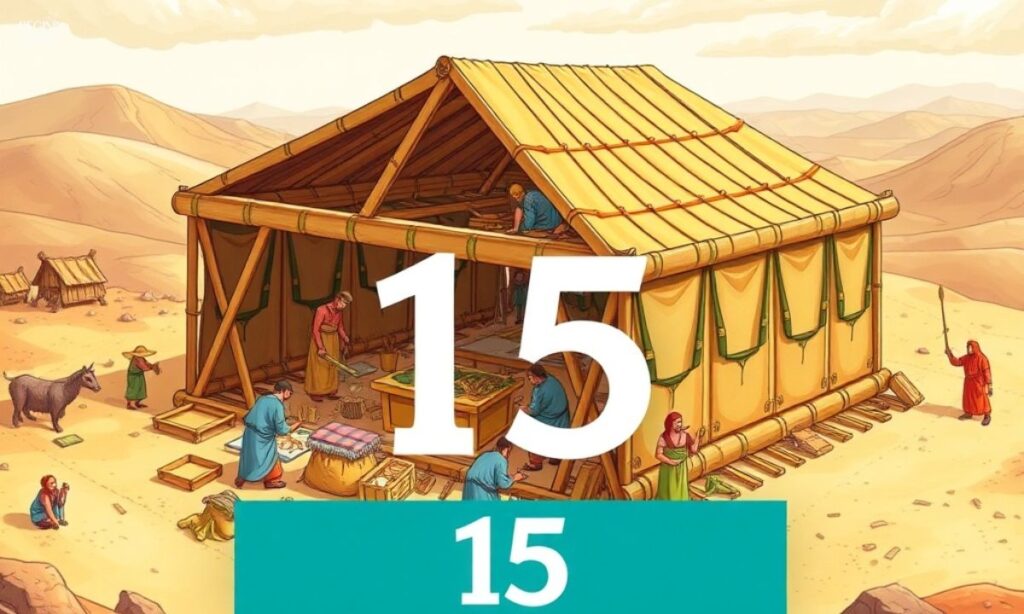
- Exodus 27:14-15 describes the courtyard of the Tabernacle, where the hangings on one side were 15 cubits long with three pillars and three bases. The Tabernacle represented God’s dwelling place among His people Israel during their wilderness journey from Egypt to Canaan. Every measurement and material was specified by God Himself, reflecting the precision required in worship and approach to the Holy One. These curtains created boundaries between the sacred space and the common areas where the Israelites camped.
- The construction details of the Tabernacle in Exodus reveal God’s desire to dwell intimately with His covenant people while maintaining His holiness. The 15-cubit hangings on either side of the entrance provided symmetry and beauty to the courtyard’s eastern entrance. Skilled craftsmen like Bezalel were filled with God’s Spirit to execute the intricate designs with gold, silver, bronze, and fine linens. The Tabernacle foreshadowed Christ, who would “tabernacle” among us as Immanuel, God with us.
- In Exodus 38:14-15, the account confirms that the hangings for the one side of the gate were 15 cubits, matching the opposite side perfectly. This symmetrical design emphasized order, balance, and the perfection of God’s instructions given to Moses on Mount Sinai. The courtyard measurements created a sacred space where sacrifices could be offered and where God’s presence would manifest in the Holy of Holies. Every detail pointed forward to the ultimate sacrifice of Christ and the true sanctuary in heaven.
The Number 15 in the Bible – The Passover — Leviticus 23
- Leviticus 23:6 establishes that on the fifteenth day of the first month (Nisan/Abib) begins the Feast of Unleavened Bread, following immediately after Passover. This seven-day feast commemorated Israel’s hasty exodus from Egypt when they had no time to let their bread rise. The removal of leaven symbolized the putting away of sin and corruption from their households and hearts. This feast remains one of God’s appointed times that reveals His redemptive plan through Christ, our Passover Lamb.
- The Feast of Unleavened Bread beginning on the 15th of Nisan was a perpetual ordinance throughout Israel’s generations as commanded in Leviticus 23. During these seven days, no work was permitted on the first and last days, which were designated as holy convocations. The Israelites were to eat only unleavened bread, remembering how God delivered them with a mighty hand from Egyptian bondage. This feast prophetically points to the sinless life of Christ and the believer’s call to holy living.
- God commanded in Leviticus 23 that the 15th day of the seventh month would also mark the beginning of the Feast of Tabernacles. These appointed feasts created a rhythm of remembrance, worship, and prophetic anticipation for God’s people throughout the year. The precision of these dates demonstrates that God operates according to His perfect timing and purposeful calendar. Each feast carries both historical and prophetic significance, connecting Israel’s past redemption with future fulfillment in Messiah.
The Number 15 in the Bible – The Feast of Tabernacles in the Old Testament
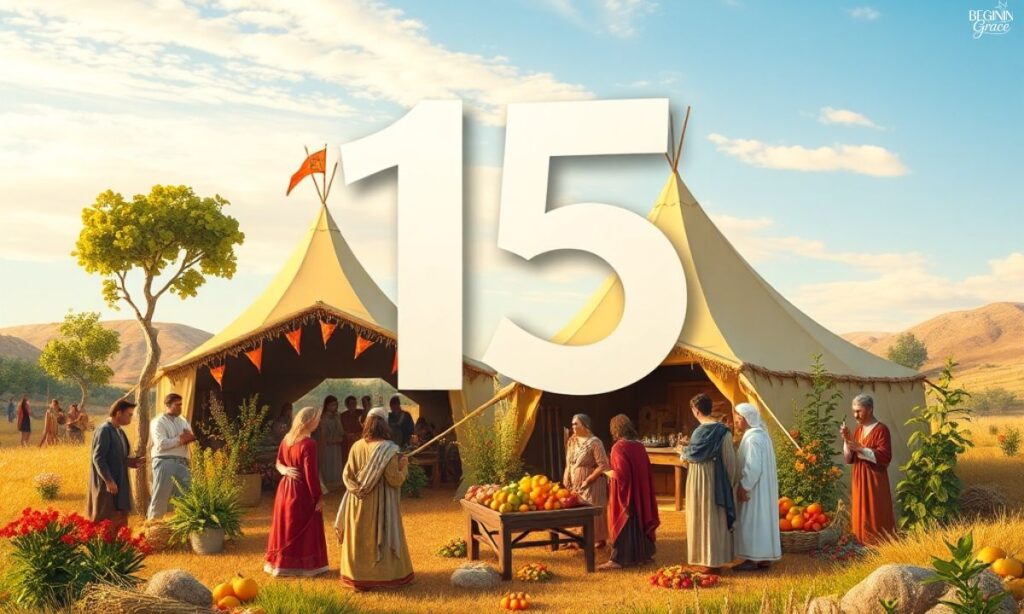
- Leviticus 23:34 commands that the Feast of Tabernacles (Sukkot) begins on the 15th day of the seventh month and continues for seven days. During this feast, Israelites lived in temporary booths or shelters made from branches, commemorating their wilderness wandering when they dwelled in tents. This joyful celebration followed the fall harvest and reminded the people that God was their provider and protector throughout their journey. The feast emphasized dependence on God rather than permanent earthly dwellings or security.
- The Feast of Tabernacles on the 15th of Tishri was the final major feast of the biblical year, representing completion and fulfillment. Israelites from all twelve tribes would gather in Jerusalem, bringing offerings and celebrating God’s faithfulness with great rejoicing and thanksgiving. The temporary booths served as tangible reminders that their ancestors had no permanent homes during the 40-year wilderness journey. This feast also anticipated the future day when God’s presence would permanently dwell among His people in the Messianic kingdom.
- Deuteronomy 16:13-15 reinforces the command to celebrate the Feast of Tabernacles for seven days after gathering harvest from the threshing floor and winepress. This agricultural timing connected God’s provision of daily bread with the spiritual reality that He alone sustains His people’s lives. The celebration included rejoicing with sons, daughters, servants, Levites, strangers, orphans, and widows—demonstrating inclusive community and generous hospitality. God promised to bless all their work and produce, making this a feast of overwhelming joy and thanksgiving.
The Number 15 in the Bible – Feast of Tabernacles — Future Millennial Reign
- Zechariah 14:16-19 prophesies that during Christ’s millennial reign, all surviving nations will come yearly to Jerusalem to worship the King and celebrate the Feast of Tabernacles. Those who refuse to come will receive no rain, demonstrating that this feast will be mandatory worship during the thousand-year kingdom. This future observance transforms the Feast of Tabernacles from historical commemoration to actual participation in Messiah’s earthly rule from Jerusalem. The feast will celebrate God’s permanent dwelling with mankind as prophesied throughout Scripture.
- The Feast of Tabernacles on the 15th day of the seventh month takes on ultimate fulfillment when Christ establishes His kingdom on earth. Revelation 21:3 declares that God’s tabernacle will be with men, and He will dwell with them as their God forever. What Israel celebrated in temporary shelters will become permanent reality when the King of Kings reigns from David’s throne in Jerusalem. Nations will stream to Zion to learn God’s ways and walk in His paths during this unprecedented era of peace.
- During the millennial reign, the Feast of Tabernacles became the primary worship event where Gentile nations join with Israel to honor King Jesus. Isaiah 2:2-3 describes how the mountain of the Lord’s house will be established and exalted above all hills in those days. The feast that began as a wilderness memorial will culminate in global worship of the Messiah who tabernacled among us in John 1:14. This prophetic fulfillment demonstrates God’s consistent plan to dwell with His people throughout all ages and dispensations.
The Number 15 in the Bible – Numbers Chapter 15
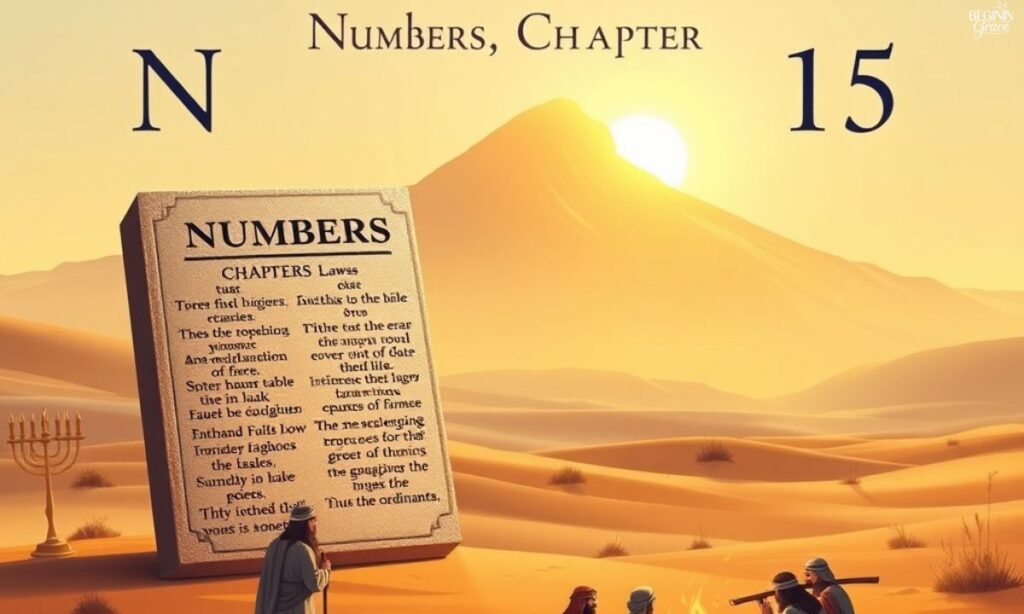
- Numbers 15 provides detailed instructions for offerings and sacrifices that Israel must present once they enter the Promised Land of Canaan. The chapter addresses grain offerings, drink offerings, and the proportions required for different types of animals presented before the Lord. God specifies that one law shall apply equally to native-born Israelites and foreigners residing among them, demonstrating His impartial justice. The chapter also addresses unintentional sins versus defiant, high-handed rebellion against God’s commandments and their respective consequences.
- In Numbers 15:32-36, the account of a man gathering sticks on the Sabbath day illustrates the seriousness of willfully breaking God’s commands. The man was brought before Moses, Aaron, and the congregation, and God declared he must be put to death by stoning. This severe judgment demonstrated that the Sabbath was a sign of the covenant between God and Israel that must be honored. The incident reinforced that approaching God required reverence, obedience, and careful attention to His revealed will through the law.
- Numbers 15:37-41 concludes with God commanding the Israelites to make tassels on the corners of their garments with blue cords throughout their generations. These tassels served as visual reminders to obey all of God’s commandments and not follow after their own hearts and eyes. The blue cord represented the heavenly origin of the law and their calling as God’s holy, separated people among the nations. This practice would distinguish Israel and constantly remind them of their covenant relationship and obligations to the Lord their God.
The Number 15 in the Bible – 14th and 15th Day of the Month Adar
- Esther 9:17-19 records that the Jews rested on the 15th day of Adar after defending themselves against enemies on the 13th and 14th days. The Jews in the provinces celebrated Purim on the 14th, while those in Susa celebrated on the 15th after an extended battle. This deliverance from Haman’s genocidal plot became an annual festival of feasting, joy, and giving gifts to commemorate God’s providence and protection. The Book of Esther demonstrates God’s hidden hand working through circumstances to preserve His covenant people even in exile.
- The establishment of Purim on the 14th and 15th of Adar created a perpetual memorial of how Queen Esther risked her life to save the Jewish people. Mordecai sent letters to all Jews throughout King Ahasuerus’s provinces, commanding them to observe these days annually with celebration and thanksgiving. The contrast between Haman’s planned destruction and Israel’s deliverance showcases God’s sovereign reversal of evil schemes against His chosen people. These days became times of sending food portions to one another and gifts to the poor, demonstrating community solidarity and generosity.
- Esther 9:21 establishes that Jews should observe both the 14th and 15th days of Adar annually, depending on whether they lived in unwalled or walled cities. This distinction honored the different experiences of provincial Jews versus those in the capital city of Susa during the conflict. The feast of Purim celebrates God’s faithfulness to preserve Israel even when His name is not explicitly mentioned in the biblical narrative. The story reminds believers that God works providentially behind the scenes to accomplish His promises and protect His people from destruction.
The Number 15 in the Bible – The Hosea and Gomer

- Hosea 3:2 records that the prophet purchased his unfaithful wife Gomer back for 15 shekels of silver and a homer and a half of barley. This redemption price illustrated God’s love for Israel despite her spiritual adultery and pursuit of false gods throughout the surrounding nations. The 15 shekels represented half the price of a slave in Exodus 21:32, symbolizing Gomer’s degraded condition through her unfaithfulness. Hosea’s faithful love for his wayward wife powerfully portrayed God’s covenant love (hesed) that pursues and redeems unfaithful people despite their betrayal.
- The command for Hosea to redeem Gomer in Hosea 3 demonstrated the costliness of redemption and the patience of divine love that waits for restoration. Though Gomer had been unfaithful and prostituted herself, Hosea paid the redemption price and brought her back into a covenant relationship. The combination of silver and barley indicated Hosea may have used everything he had to purchase her freedom from slavery or bondage. This prophetic marriage enacted God’s determination to restore Israel after her exile and judgment for covenant unfaithfulness and idolatry.
- Hosea’s redemption of Gomer for 15 shekels of silver presents one of Scripture’s most powerful illustrations of redeeming love overcoming betrayal and shame. The prophet was commanded to love an adulteress even as the Lord loved the children of Israel who turned to other gods. After the redemption, Gomer was to remain faithful, abstaining from prostitution while Hosea remained devoted to her during a period of testing. This prophetic action foreshadowed God’s ultimate redemption of unfaithful humanity through Christ, who paid the ultimate price for our restoration to relationship with God.
The Number 15 in the Bible – King Hezekiah
- 2 Kings 20:6 and Isaiah 38:5 record God’s promise to add 15 years to King Hezekiah’s life after he prayed with tears for healing. Hezekiah had become mortally ill, and Isaiah initially delivered a message that the king should prepare to die without recovery. After Hezekiah’s fervent prayer, God sent Isaiah back with the promise of healing and the sign that the shadow would go backward ten degrees. These additional 15 years demonstrated God’s compassion, His responsiveness to prayer, and His sovereign ability to reverse even death sentences when His purposes allow.
- During the 15 years added to Hezekiah’s life, he witnessed God’s deliverance of Jerusalem from the Assyrian army under Sennacherib’s siege in 701 BC. The angel of the Lord struck down 185,000 Assyrian soldiers in one night, vindicating God’s promise to defend the city for His own sake. Hezekiah also received envoys from Babylon, whom he foolishly showed all his treasures, leading to Isaiah’s prophecy of future Babylonian captivity. These extended years proved to be a mixed blessing, as Hezekiah’s son Manasseh, born during this period, would become one of Judah’s most wicked kings.
- The miraculous sign confirming God’s promise to Hezekiah involved the shadow on the sundial moving backward ten degrees, defying natural law. This astronomical reversal demonstrated that the God who controls creation could certainly add 15 years to a man’s appointed time on earth. Hezekiah’s healing and the defeat of Assyria both occurred around 701 BC, marking one of Judah’s greatest moments of divine deliverance. The king’s psalm of thanksgiving in Isaiah 38:10-20 expresses profound gratitude for restoration to life and the privilege of continuing to praise God among the living.
- The addition of 15 years to Hezekiah’s life in 2 Kings 20 raises theological questions about prayer’s power to change God’s declared intentions. God had sent Isaiah to tell Hezekiah to set his house in order because death was imminent and certain without divine intervention. Yet Hezekiah’s tears and appeals to his faithful walk with God moved the Lord to grant an extension of life. This account demonstrates that God responds to the prayers of the righteous and that His initial declarations may include implicit conditions based on human response.
- King Hezekiah ruled Judah for 29 years total, with the final 15 years being a gracious extension beyond his appointed time of death. During his reign, Hezekiah led significant religious reforms, removing high places, breaking sacred pillars, and cutting down the Asherah pole that had corrupted worship. He trusted in the Lord God of Israel more than any king before or after him according to 2 Kings 18:5’s commendation. The additional 15 years allowed Hezekiah to continue his reforming work and experience God’s miraculous deliverance from the seemingly unstoppable Assyrian military machine.
- The account of Hezekiah’s healing and 15-year life extension appears in three biblical passages: 2 Kings 20, 2 Chronicles 32, and Isaiah 38-39. This repetition emphasizes the event’s significance in Judah’s history and in demonstrating God’s character as merciful, powerful, and responsive to prayer. The poultice of figs applied to Hezekiah’s boil showed that God often works through natural means even while performing supernatural healing. Hezekiah’s experience encourages believers to bring their desperate situations before God in honest, fervent prayer, trusting His compassion and sovereign power over life and death.
- During the 15 additional years granted to Hezekiah, he accumulated great wealth and honor, receiving tribute from nations and respect from neighboring kingdoms. 2 Chronicles 32:27-29 describes his treasuries filled with silver, gold, precious stones, spices, shields, and all kinds of valuable articles. He constructed storage facilities for grain, wine, oil, and stalls for various kinds of cattle, along with sheepfolds for his flocks. However, his pride in showing these riches to Babylonian envoys revealed a character flaw that Isaiah rebuked, prophesying that everything would eventually be carried away to Babylon.
- The theological significance of Hezekiah’s 15-year extension reminds believers that our times are in God’s hands, as declared in Psalm 31:15. While God has appointed the days of our lives, this account demonstrates His willingness to hear and answer prayers according to His will and purposes. Hezekiah’s healing served multiple purposes: rewarding faithfulness, allowing continued reforms, providing more time to father an heir, and demonstrating God’s power to surrounding nations. The narrative ultimately points to God’s sovereignty over life and death and His compassionate response to those who seek Him with sincere hearts.
The Number 15 in the Bible – New Testament
The Number 15 in the Bible – Date of John the Baptist’s Ministry
Luke 3:1-2 (NIV) In the fifteenth year of the reign of Tiberius Caesar—when Pontius Pilate was governor of Judea, Herod tetrarch of Galilee, his brother Philip tetrarch of Iturea and Traconitis, and Lysanias tetrarch of Abilene—during the high priesthood of Annas and Caiaphas, the word of God came to John son of Zechariah in the wilderness.
Matthew 3:1-3 (KJV) In those days came John the Baptist, preaching in the wilderness of Judaea, and saying, Repent ye: for the kingdom of heaven is at hand. For this is he that was spoken of by the prophet Esaias, saying, The voice of one crying in the wilderness, Prepare ye the way of the Lord, make his paths straight.
Mark 1:4-5 (ESV) John appeared, baptizing in the wilderness and proclaiming a baptism of repentance for the forgiveness of sins. And all the country of Judea and all Jerusalem were going out to him and were being baptized by him in the river Jordan, confessing their sins.
John 1:19-23 (NIV) Now this was John’s testimony when the Jewish leaders in Jerusalem sent priests and Levites to ask him who he was. He did not fail to confess, but confessed freely, “I am not the Messiah.” They asked him, “Then who are you? Are you Elijah?” He said, “I am not.” “Are you the Prophet?” He answered, “No.”
The Number 15 in the Bible – Bethany and Jerusalem
John 11:1 (NIV) Now a man named Lazarus was sick. He was from Bethany, the village of Mary and her sister Martha. This is the same Mary who poured perfume on the Lord and wiped his feet with her hair.
John 12:1-3 (ESV) Six days before the Passover, Jesus therefore came to Bethany, where Lazarus was, whom Jesus had raised from the dead. So they gave a dinner for him there. Martha served, and Lazarus was one of the guests reclining at table with him. Mary therefore took a pound of expensive ointment made from pure nard, and anointed the feet of Jesus and wiped his feet with her hair.
Matthew 21:17 (KJV) And he left them, and went out of the city into Bethany; and he lodged there. Now in the morning as he returned into the city, he hungered.
Luke 24:50-51 (NIV) When he had led them out to the vicinity of Bethany, he lifted up his hands and blessed them. While he was blessing them, he left them and was taken up into heaven.
The Number 15 in the Bible – Safe Anchor Depth
Acts 27:28-29 (NIV) When they took soundings, they found that the water was a hundred and twenty feet deep. A short time later they took soundings again and found it was ninety feet deep. Fearing that we would be dashed against the rocks, they dropped four anchors from the stern and prayed for daylight to come.
Psalm 23:4 (KJV) Yea, though I walk through the valley of the shadow of death, I will fear no evil: for thou art with me; thy rod and thy staff they comfort me. Thou preparest a table before me in the presence of mine enemies: thou anointest my head with oil; my cup runneth over.
Hebrews 6:19 (ESV) We have this as a sure and steadfast anchor of the soul, a hope that enters into the inner place behind the curtain, where Jesus has gone as a forerunner on our behalf, having become a high priest forever after the order of Melchizedek.
Proverbs 22:3 (NIV) The prudent see danger and take refuge, but the simple keep going and pay the penalty. Humility is the fear of the Lord; its wages are riches and honor and life.
The Number 15 in the Bible – Paul and Peter
Galatians 2:11-12 (ESV) But when Cephas came to Antioch, I opposed him to his face, because he stood condemned. For before certain men came from James, he was eating with the Gentiles; but when they came he drew back and separated himself, fearing the circumcision party.
Corinthians 15:5 (NIV) and that he appeared to Cephas, and then to the Twelve. After that, he appeared to more than five hundred of the brothers and sisters at the same time, most of whom are still living, though some have fallen asleep.
Acts 15:7-9 (KJV) And when there had been much disputing, Peter rose up, and said unto them, Men and brethren, ye know how that a good while ago God made choice among us, that the Gentiles by my mouth should hear the word of the gospel, and believe. And God, which knoweth the hearts, bears them witness, giving them the Holy Ghost, even as he did unto us; and put no difference between us and them, purifying their hearts by faith.
The Number 15 in the Bible – Acts Chapter 5
Acts 5:12-13 (ESV) Now many signs and wonders were regularly done among the people by the hands of the apostles. And they were all together in Solomon’s Portico. None of the rest dared join them, but the people held them in high regard. And more than ever believers were added to the Lord, multitudes of both men and women.
Frequently Asked Questions
What does the number 15 symbolize in the Bible
It often represents rest, deliverance, and God’s grace shown to His people.
Why is the 15th day important in Scripture
Many key events and feasts in the Bible happened on the fifteenth day of the month.
Where is the number 15 first mentioned in the Bible
It appears in the context of dates and events linked to God’s timing.
Is the number 15 connected to God’s festivals
Yes, several biblical feasts begin on the fifteenth day, showing joy and freedom.
What spiritual meaning is linked to the number 15
It reflects blessings, new beginnings, and God’s mercy.
Does the number 15 relate to deliverance
Yes, it is connected to moments where God brings rescue and hope.
How many times does the number 15 appear in the Bible
It appears in various chapters where dates and events are highlighted.
Does the number 15 symbolize grace in the Bible
Many scholars link it with grace because it combines numbers that represent divine favor.
Is the number 15 used in prophetic events
It shows up in timelines that point to God’s perfect plan.
Why is studying the number 15 helpful
It helps readers see deeper meaning and spiritual patterns in Scripture.
Conclusion
The number 15 in the Bible carries rich and meaningful symbolism. It often points to God’s grace and His acts of deliverance. These stories help us see how God brings hope in hard times. They remind us that His timing is always perfect.
As we study these examples, we understand the deeper message behind the number. It teaches us to trust God’s plan even when we cannot see it. The number 15 shows how God works with love and purpose. Its symbolism gives strength and faith to our lives.

Samuel Reed is a devoted Christian writer with 4 years of experience sharing Bible verses, blessings, and prayers on Beginingrace.com. His writings reflect faith, hope, and the peaceful message of God’s grace for every heart