
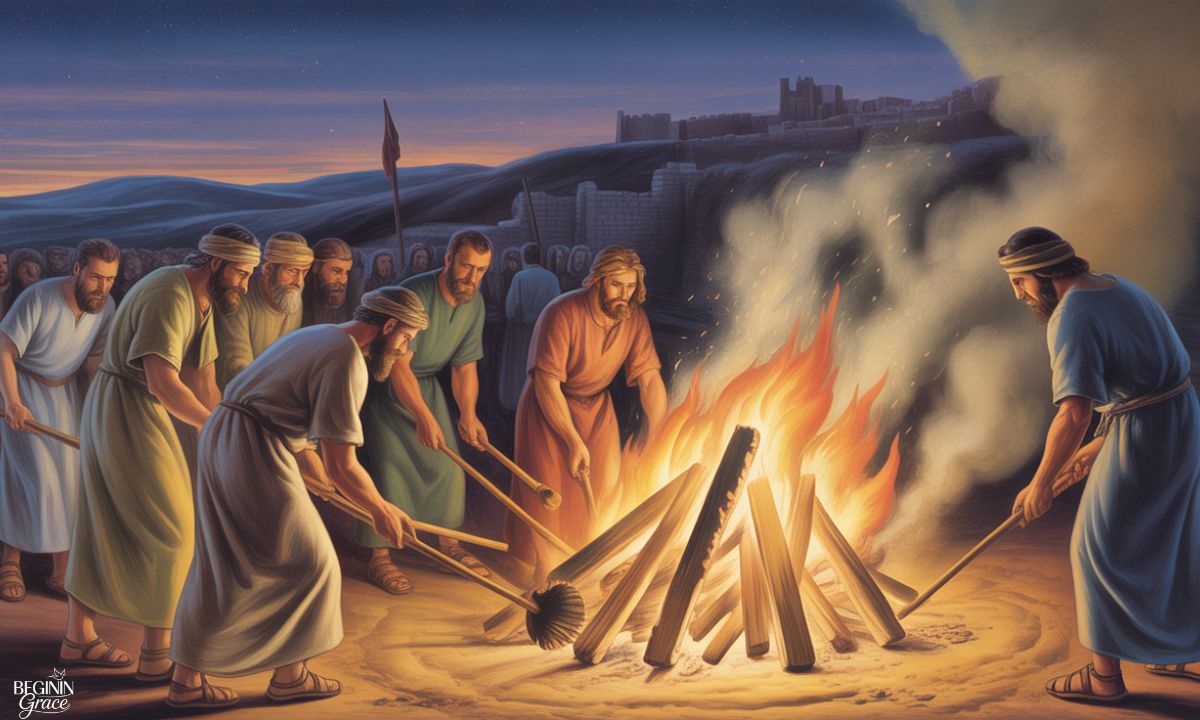
The Bible mentions a few events related to burning bodies, but it does not clearly show a normal cremation like we see today. Some people in the Bible were burned as a punishment, not as a burial choice. Because of this, many readers wonder who was the first person cremated. The answer is not simple, and it needs careful understanding. This topic helps us see how burial practices were different in ancient times.
In the Bible, the common way to handle the dead was burial, not cremation. Burning bodies was usually linked with judgment or wrongdoing. This makes the subject interesting because it shows cultural and spiritual beliefs of that time. When we study these events, we learn the difference between cremation and punishment by fire. Understanding this helps us read the Bible with clarity.
Who Was The First Person Cremated In The Bible? – Old Testament
If you have ever wondered who the first person cremated in the Bible was, it truly is an interesting and often overlooked question. The Bible does not use the words “cremation, cremated,” or “cremate” in the King James Version, and this makes the topic even more curious. When we talk about cremation, we simply mean the burning of a body after death. This includes burning bones or remains as a way of dealing with someone who has died. Although cremation was not common in Israel, the Old Testament does mention a few events where burning of a body or bones took place. These moments give us a glimpse into how ancient people viewed death, honor, judgment, and burial.
Many people today have different opinions about cremation. In my own life, there was a time when I thought cremation made sense and seemed practical. I never really stopped to ask myself what the Bible says about it or whether God had a specific pattern regarding burial. My thinking changed when my uncle shared his experience. He once dated a woman who strongly believed in cremation after death. Their relationship ended for many reasons, but one of the things that bothered him was her firm desire to be cremated. He explained to me that he had Biblical reasons for not supporting cremation, and his thoughts made me look deeper into Scripture and understand the topic more clearly.
When we study the Old Testament, we find that cremation was usually connected to judgment, disgrace, or severe circumstances, rather than being a normal or honorable way of handling a body. Most Israelites believed in burial because it symbolized respect, peace, and the hope of resurrection. The burning of a body, on the other hand, often showed shame or punishment. Still, these few recorded moments in the Bible help answer our question and open the door to a wider discussion on how God’s people understood life, death, and dignity.
By exploring these examples carefully, we can understand the cultural and spiritual background behind cremation in Biblical times. This helps us not only answer the historical question but also reflect on how the Bible guides our own thinking today.
Who Was The First Person Cremated In The Bible? – Two Cities
According to a Bible study method called the law of first mention, the first time a word or idea appears in Scripture helps us understand how God views that topic. When we look at the subject of burning bodies, the earliest example in the Bible is not about a single person, but about the people of Sodom and Gomorrah. These two cities were known for their great sin, and their destruction gives us a picture of how serious their behavior had become.
The Bible clearly explains the condition of the people in Sodom. It shows that their wickedness was open, bold, and continually increasing. God’s judgment on these cities came in the form of fire and brimstone, which completely consumed the inhabitants. This is why many believe this event represents the first example of bodies being burned after death in Scripture.
Genesis 13:13 says, “But the men of Sodom were wicked and sinners before the LORD exceedingly.
This verse stands out in another interesting way. It contains two occurrences of the number 13, which many Bible students see as a symbol of rebellion in biblical numerology. Whether or not one places strong emphasis on numbers, it is still a striking detail that fits the overall picture of Sodom’s behavior.
In simple words, the first burning of people in the Bible happened when God judged Sodom and Gomorrah. It was not a normal cremation like we think of today, but it was still the first time bodies were burned as part of a divine act of judgment.
Who Was The First Person Cremated In The Bible? – First Cremation
The Bible shows that the very first act that resembles cremation was not done by people, but by God Himself. When God judged the cities of Sodom and Gomorrah, He sent fire from heaven that completely burned the people living there. This burning was so strong that nothing remained. So, in a way, the first “cremation” mentioned in Scripture was the destruction of these cities and their people.
This was not a normal funeral or a human cremation. It was an act of God’s judgment because of the great sin and wickedness in those cities. The Bible uses very strong language to describe how powerful that fire was.
Genesis 19:24 – God Sent Fire to Destroy
Then the LORD rained upon Sodom and upon Gomorrah brimstone and fire from the LORD out of heaven. (KJV)
In simple words, God sent burning fire and hot sulfur straight from the sky. It fell on the cities with such force that everything was burned up. The people, the buildings, and the land were all destroyed in an instant. This was not just a small fire, it was a heavenly fire that no one could escape.
Genesis 19:28 – The Effects of the Heavenly Fire
This verse shows what Abraham saw afterward:
And he looked toward Sodom and Gomorrah, and toward all the land of the plain, and beheld, and, lo, the smoke of the country went up as the smoke of a furnace. (KJV)
In simple words, when Abraham looked from far away, he saw huge clouds of smoke rising up into the sky, just like smoke coming from a giant furnace. This shows that the fire completely consumed the cities. Nothing survived. It was a total destruction, like a mass cremation caused by God.
Who Was the First Person Cremated in the Bible? — Achan — The “Troubler of Israel
Achan was the man who disobeyed God, and because of his sin, the whole nation of Israel suffered. When his actions were discovered, God’s anger rested on the people, and they needed to remove the sin from among them. Achan was proven guilty, and his punishment was very serious. The people of Israel stoned him and his entire family. After they were dead, their bodies were burned with fire. The Bible says in Joshua 7:25, And all Israel stoned him with stones, and burned them with fire, after they had stoned them.
This event may be the first clear example of cremation among the Hebrew people. Achan and his family were not given a normal burial. Instead, they were burned as a sign of judgment for their actions. He is remembered as “the troubler of Israel, as mentioned in 1 Chronicles 2:7. His cremation showed the seriousness of his sin and the great trouble he brought upon the people.
Who Was The First Person Cremated In The Bible? – The Body Of King Saul
King Saul’s death is one of the most talked-about events in the Old Testament. After Saul and his sons were killed in battle, something unusual happened to their bodies. The Bible tells us that the brave men of Jabesh-Gilead went at night, took the bodies from the wall of Beth-shan, and then burned them in Jabesh. After burning, they collected the bones and buried them under a tree. This account is found in 1 Samuel 31:12-13. Because of the word “burnt”, many people believe that Saul may have been the first person in the Bible to receive something that looks like cremation.
However, cremation was not a normal practice among the Israelites. They usually buried the body as it was. So why was Saul’s body burned? Many Bible scholars explain that this burning was not a full cremation. Instead, it may have been a cleansing or purifying action, because Saul’s dead body had been exposed, mistreated, and possibly infected after being displayed by the Philistines. After burning, the bones were respectfully gathered and buried, which shows that the main focus was still on burial, not cremation.
The courage and loyalty of the men of Jabesh-Gilead did not go unnoticed. In 2 Samuel 2:4-5, when David became king, he praised these men for honoring Saul. He blessed them for their kindness and thanked them for giving their former king a proper burial. This shows how important respect for the dead was in Israelite culture.
Another writer in the Bible repeated this same story in 1 Chronicles 10:12, again highlighting that the bones of Saul and his sons were buried under the oak in Jabesh. All three passages, 1 Samuel, 2 Samuel, and 1 Chronicles, focus on the burial, not the burning. The burning is mentioned only once, and it seems to have been a special situation because of the condition of the bodies.
The men of Jabesh-Gilead loved their king, and even though his body was badly treated by the enemy, they risked their lives to honor him. They burned the bodies, most likely to clean them, and then buried the bones with respect. This action was a brave and loving tribute, and King David appreciated it deeply.
Who Was The First Person Cremated In The Bible? – Burnings

In the Bible, the word burning is often used to describe how the bodies of some important Israelite kings were treated after death.
There are two clear examples, and in both cases, the kings were from the kingdom of Judah.
2 Chronicles 16:14 – Good King Asa
This verse tells us that the good King Asa was buried in the city of David, in the tomb he had prepared for himself. His body was laid on a bed filled with sweet-smelling spices, carefully prepared by skilled workers. A “very great burning” was made for him. Here, “burning” does not mean punishment or destruction, it was a way to honor the king after his death. People burned spices and incense to create pleasant smells, showing respect, love, and admiration for the king. This was part of a traditional funeral for someone important and beloved.
2 Chronicles 21:19 – Evil King Jehoram
In contrast, King Jehoram suffered from a serious disease and died after two years. But for him, no burning was made, unlike the burials of his ancestors. This shows that the people did not honor him in the same way. He was not considered beloved or respected, and the funeral did not include the traditional burning and spices.
Burnings in Ancient Israel – A Sign of Honor
From these two examples, we can see that in ancient Israel, “burning” was a way to show respect and honor at a funeral. It was not just lighting a fire; it involved using sweet-smelling spices and incense to honor the deceased. Today, we might honor someone with flowers or candles, back then, they used burning incense and spices.
This also shows that the kind of funeral reflected the king’s life and character. A good and loved king received a grand burning to show respect, while an evil or disliked king did not. Burnings were a cultural way of showing love, honor, and remembrance for the person who had passed away.
Who Was The First Person Cremated In The Bible? -Idolatry And Human Sacrifice
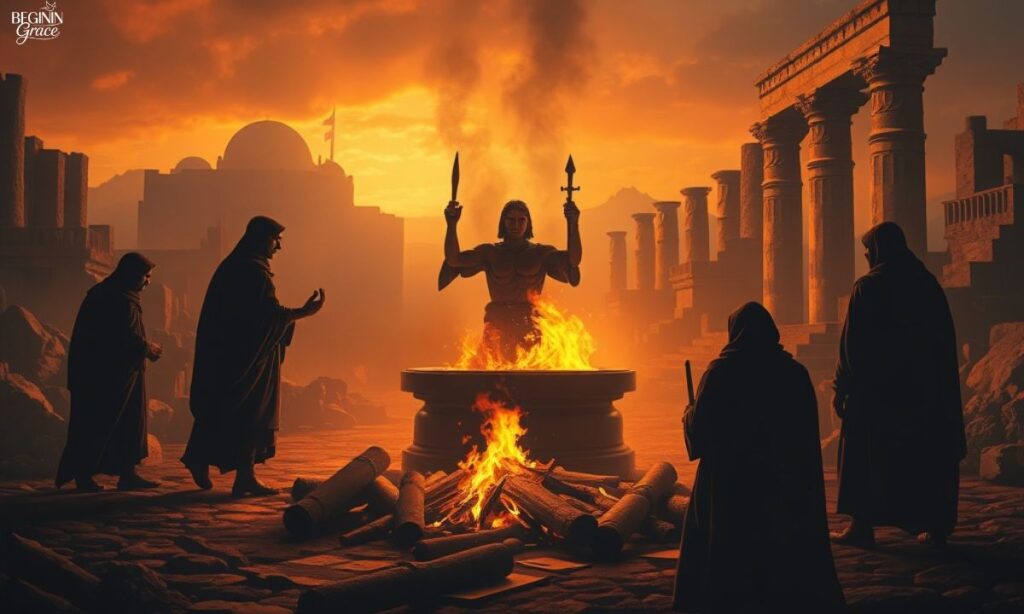
Many of the nations around Israel practiced cremation as a way to sacrifice humans to their gods. This was considered an abomination. God did not want human sacrifices and strictly prohibited such practices. He commanded His people to avoid following these evil customs. Cremation in these cases was linked to idolatry, not a proper burial or honoring of the dead.
Leviticus 18:21 – God Commanded Against Child Sacrifice
In the Bible, God clearly warned His people not to offer their children to false gods. Leviticus 18:21 says, “And thou shalt not let any of thy seed pass through the fire to Molech, neither shall thou profane the name of thy God: I am the LORD.” This means God did not want human sacrifice. Children are a gift from God, and He values their lives. He commanded the Israelites to keep their children safe and not to follow the evil customs of the nations around them. God’s instructions show His love and care for His people and especially for their children.
Deuteronomy 18:10 – God Repeated His Warning Against Child Sacrifice
God reminded the people again in Deuteronomy 18:10 not to make their sons or daughters pass through fire as a sacrifice. The verse also warns against other sinful practices like divination, witchcraft, and using spells. God wanted His people to live differently from the heathen nations who practiced such evil things. Even though God is good and loving, humans have free will. Sometimes, the Israelites still chose to follow sinful ways. God’s repeated warnings show how important it is to obey Him and keep away from harmful practices.
2 Chronicles 28:3 – King Ahaz Sacrificed His Children As An Offering To A False God
Even though God warned against child sacrifice, some kings of Israel did wrong things. King Ahaz, for example, offered his children as sacrifices to false gods. The Bible says, “Moreover he [King Ahaz] burnt incense in the valley of the son of Hinnom, and burnt his children in the fire, after the abominations of the heathen whom the LORD had cast out before the children of Israel.” This shows that even leaders could make terrible choices and follow the evil ways of surrounding nations. Their actions caused great sorrow and anger before God.
2 Kings 21:6 – King Manasseh Sacrificed His Son To A False God
Another example is King Manasseh. He also sacrificed his son to a false god and practiced witchcraft and other evil deeds. The Bible says, And he [King Manasseh] made his son pass through the fire, and observed times, and used enchantments, and dealt with familiar spirits and wizards: he wrought much wickedness in the sight of the LORD, to provoke him to anger.” This shows how even kings could fall into sin and lead their people into evil. God’s heart is saddened when humans choose such ways, but His warnings and commandments are always there to guide us back.
Jeremiah 19:5 – The Prophet Jeremiah Mourned Over Idolatrous Evil Practices
The prophet Jeremiah was deeply grieved when he saw these sinful acts. He saw the people building places to worship false gods and sacrifice their children. The Bible says, They have also built the high places of Baal, to burn their sons with fire for burnt offerings unto Baal, which I commanded not, nor spake it, neither came into my mind. Jeremiah’s sorrow shows how serious and sad these practices were in the eyes of God. God never wanted people to harm their children.
Jeremiah 32:35 – The Prophet Jeremiah Wept Over The Practice Of Child Sacrifice
Jeremiah also spoke about the evil done in Judah, saying, “And they built the high places of Baal, which are in the valley of the son of Hinnom, to cause their sons and their daughters to pass through the fire unto Molech; which I commanded them not, neither came it into my mind, that they should do this abomination, to cause Judah to sin.” These verses show how strongly God feels about human sacrifice and idolatry. It was an abomination, and it caused God’s people to sin.
The Bible clearly teaches that burning children as a sacrifice was always wrong. These practices were part of heathen cultures, not God’s ways. Godly people honor life, love their children, and treat the body with respect. In Christian culture, instead of burning, we remember the dead with proper burials, prayers, and respect for their memory. God values life, obedience, and love above all
Who Was The First Person Cremated In The Bible? – New Testament
The early Christians practiced burial not cremation.
Matthew 14:12 – John The Baptist Was Buried
Matthew 14:12 says:
And his disciples came, and took up the body, and buried it, and went and told Jesus.” (KJV)
This verse tells us that after John the Baptist was killed, his disciples came to take care of his body. They buried him properly and then went to tell Jesus what had happened. Even though this story is written in the New Testament, it is important to remember that John and his followers were not Christians, because the term “Christian” was only used after Jesus rose from the dead and ascended into heaven.
What this event shows us is very important: the Jewish people buried their dead, they did not burn them. This was their custom and tradition. They treated their dead with respect and care. Burial was a sign of honor, love, and remembrance, and it was considered the proper way to deal with the dead.
Early Christians also followed this tradition of burial. They continued the practice of honoring the dead by burying them in graves. Even when people died suddenly or under tragic circumstances, they were still buried.
Acts 5:9-10 – Ananias And Sapphira Were Buried
Acts 5:9-10 tells the story of Ananias and Sapphira:
Then Peter said unto her, How is it that ye have agreed together to tempt the Spirit of the Lord? behold, the feet of them which have buried thy husband are at the door, and shall carry thee out. Then fell her down straightway at his feet, and yielded up the ghost: and the young men came in, and found her dead, and, carrying her forth, buried her by her husband. (KJV)
Even though Ananias and Sapphira had sinned by lying to God, they were still buried. This shows that burial was the normal and accepted way to care for someone after death, regardless of their mistakes or sins. The body was always treated with respect, and burial remained the custom of the early church.
Acts 8:2 – Stephen – The First Martyr Was Buried
Acts 8:2 says:
And devout men carried Stephen to his burial, and made great lamentation over him.” (KJV)
Stephen was the first Christian martyr, someone who died for their faith. Even in his death, the believers honored him by burying him properly. They carried his body to a burial place and mourned deeply for him. This again shows the continuity of burial as a respectful and traditional practice. Even in times of violence or sudden death, Christians ensured that the dead were laid to rest with dignity.
Who Was The First Person Cremated In The Bible? – Burial or Cremation for the Christian Today?
The Bible does not clearly say that cremation is wrong, so many people believe that deciding what to do with a dead body is a personal choice. After a person dies, their soul immediately goes to either heaven or hell, and the way the body is handled after death does not change the eternal destiny of the soul. Whether the body is buried in the ground or cremated, God, the Creator of all things, can raise that person to new life, giving them a new body at the resurrection.
However, for Christians who want to honor God not just in life but also in death, the choice between burial and cremation matters. Burial is more than just placing a body in the ground, it is a public way of showing faith in God and hope for the future resurrection of the body. As the Bible says in 1 Corinthians 15:42, “So also is the resurrection of the dead. It is sown in corruption; it is raised in incorruption.” Burial is a visible testimony of faith, showing that the believer trusts in life after death. On the other hand, cremation can sometimes give the impression that death is the final end, without hope.
Even King Solomon, a wise man inspired by God, wrote about the sadness of a person who had everything in life but received no proper burial. He said in Ecclesiastes 6:3, “If a man beget an hundred children, and live many years, so that the days of his years be many, and his soul be not filled with good, and also that he have no burial; I say, that an untimely birth is better than he.” Cremation, especially when ashes are scattered, is not the same as a proper burial. According to Solomon, ending life without a burial is a serious loss that all the good things in life cannot make up for.
In short, while Christians can choose cremation or burial without affecting their soul, burial is a way to show faith, hope, and respect for the body God has given.
Who Was The First Person Cremated In The Bible? – Jesus Christ — Our Perfect Example
Many people wonder about cremation and burial, and what the Bible says about it. Actually, the Bible never clearly tells us that cremation is wrong, nor does it command us to bury someone. But when we look at the life of Jesus Christ, we see a clear example for Christians to follow.
Jesus Christ did not choose cremation. When he died, he was buried in a tomb. His burial shows us the way Christians are encouraged to honor the dead. In 1 Peter 2:21 (KJV), it says we are to “follow in His steps.” This means following Jesus’ example in life, death, and even burial. His life and death give us a pattern to follow, showing respect for the body He gave us while on earth.
My uncle once told me a story about someone who did not like cremation. He said, “Jesus was buried. That is why we, as Christians, should try to follow His example.” I found his thinking very wise. It reminded me that burial is not just a tradition, it connects directly to Jesus’ life and death.
Even today, when people talk about a “Christian burial, they are referring back to how Jesus was buried. Choosing to bury someone is a way of honoring Christ’s example. Personally, I hope to follow this example myself one day, and to do the same for my loved ones when their time comes. It is a way to show respect, love, and faith in God’s plan.
Frequently Asked Questions
Who was the first person cremated in the Bible
The Bible does not explicitly record anyone being cremated; most biblical figures, including Jesus, were buried.
Did the Bible mention cremation at all
Cremation is mentioned indirectly in relation to pagan practices, but it was not a common Israelite custom.
Was anyone in the Old Testament burned after death
Some kings and people were burned ceremonially in royal or pagan contexts, but these were not ordinary cremations.
Why didn’t biblical figures get cremated
Burial was the traditional practice for Israelites, reflecting respect for the body and God’s commandments.
Is cremation a sin according to the Bible
The Bible neither commands nor forbids cremation, so it is a matter of personal or cultural choice.
Were any pagan sacrifices burned in the Bible
Yes, some heathen nations burned humans as offerings to their gods, which God strictly prohibited.
Did Jesus get cremated
No, Jesus was buried according to Jewish customs, setting an example for His followers.
How about John the Baptist, was he cremated
John the Baptist was buried by his disciples, not cremated, following Jewish burial traditions.
Does cremation appear in any Bible story
Burning appears in certain stories, like human sacrifice by heathens or ceremonial fires, but not as normal burial.
Can Christians choose cremation today
Yes, Christians can choose cremation, as the Bible allows burial or cremation without sin.
Conclusion
The Bible does not clearly say who was the first person cremated. Some people think it may have been King Ahaz or others who practiced sacrifices. Cremation in the Bible is often linked to idolatry or punishment. Burial was more common for God’s people.
Today, Christians can choose burial or cremation. The important thing is the soul, not the body. God cares about faith and obedience, not the method of handling the body. We can follow His guidance and make thoughtful choices.

Samuel Reed is a devoted Christian writer with 4 years of experience sharing Bible verses, blessings, and prayers on Beginingrace.com. His writings reflect faith, hope, and the peaceful message of God’s grace for every heart