
Worship leadership is one of the most profound callings in the church. As a worship leader, you stand at the intersection of heaven and earth, inviting your congregation into encounters with the living God. This responsibility extends far beyond selecting songs or keeping time with music, you are shepherding hearts, opening spiritual doors, and creating sacred space where the Holy Spirit can move freely among His people. The weight of this calling is both humbling and exhilarating, and it requires more than natural talent or musical ability. It demands spiritual depth, theological understanding, and a heart wholly surrendered to God’s purposes.
This collection of fifty Bible verses is designed to deepen your spiritual foundation as a worship leader and equip you with scriptural foundations for your ministry. As you study these passages, may they challenge you to think differently about worship, inspire you to lead with greater authenticity, and draw you deeper into intimacy with the God you invite others to encounter.
The Foundation of Joyful Worship

#1. Come, Let Us Sing for Joy to the Lord Psalm 95:1-2
Come, let us sing for joy to the Lord; let us shout aloud to the Rock of our salvation. Let us come before him with thanksgiving and extol him with music and song.
As a worship leader, you have the distinct privilege of extending an invitation, not a command, but a warm, compelling invitation, for your congregation to enter into joy. This passage opens with movement (“come”), continues with participation (“let us sing”), and culminates in celebration. Notice that joy is not presented as something to manufacture or force; it flows naturally from recognizing God’s role as our salvation. When you lead with this foundation, you’re helping people understand that worship is a response to God’s character, not a performance for others. Your role is to awaken their awareness of why they should rejoice, because they serve the God of their salvation. Create space in your leadership for exuberant, unashamed expression. Let people know it’s not only acceptable but encouraged to bring their whole selves into worship.
#2. Let the Message of Christ Dwell Among You Richly Colossians 3:16
Let the message of Christ dwell among you richly as you teach and admonish one another with all wisdom through psalms, hymns, and songs from the Spirit, singing to God with gratitude in your hearts.
This verse reveals something essential: the primary work of worship music is not entertainment or even emotional experience, it is the embedding of Christ’s message into the hearts and minds of your people. Worship is theological education wrapped in melody. Every song you select should carry doctrinal weight and spiritual truth. When you lead your congregation through worship, you’re not merely providing a pleasant musical experience; you’re discipling them in the faith. Choose songs with lyrics that reflect the depth and complexity of Scripture. Balance contemporary expressions with theological substance. Help your congregation understand that singing together reinforces doctrine, builds community understanding of what we believe, and creates moments where truth moves from intellectual knowledge to heart knowledge. Ask yourself: Does this song teach something true about God? Will singing it repeatedly embed kingdom principles into hearts?
#3. Worship the Lord with Gladness Psalm 100:2

Worship the Lord with gladness; come before him with joyful songs.
Gladness in worship is not superficial happiness or forced smiling, it is the deep, settled joy that comes from knowing you belong to God. As you lead worship, you are teaching your congregation an emotional and spiritual truth: that being in God’s presence, knowing His love, and serving His purposes should produce genuine gladness. This is especially important on difficult days when joy doesn’t come naturally. By creating an atmosphere that celebrates God’s goodness regardless of circumstances, you give permission for people to connect with a joy that transcends their current situations. Use your facial expressions, your vocal tone, and your movements to model gladness. When you lead with authentic joy, people understand that worship isn’t contingent on feeling good; it’s a choice to recognize that we have reason to be glad because of who God is.
#4. Worship in Spirit and Truth John 4:24
God is spirit, and his worshipers must worship in the Spirit and in truth.
This perhaps most famous verse about worship’s nature contains a non-negotiable standard: authentic worship must be both Spirit-filled and truth-rooted. In contemporary worship culture, we sometimes emphasize one at the expense of the other. Some gatherings prioritize emotional, spirit-filled experiences while glossing over theological precision. Others become so focused on doctrinal correctness that they squelch the work of the Holy Spirit. Your task as a worship leader is to hold both in tension. Lead with integrity regarding Scripture’s teaching about God while remaining open to the Spirit’s movement. Choose songs that are theologically sound and prophetically alive. Create space for both the mind and the heart to engage with God. Never sacrifice truth for an experience, nor diminish the Spirit’s work by focusing only on intellectual assent. The most powerful moments in worship happen when people encounter the true God through the power of His Spirit.
#5. Offer Your Bodies as a Living Sacrifice Romans 12:1
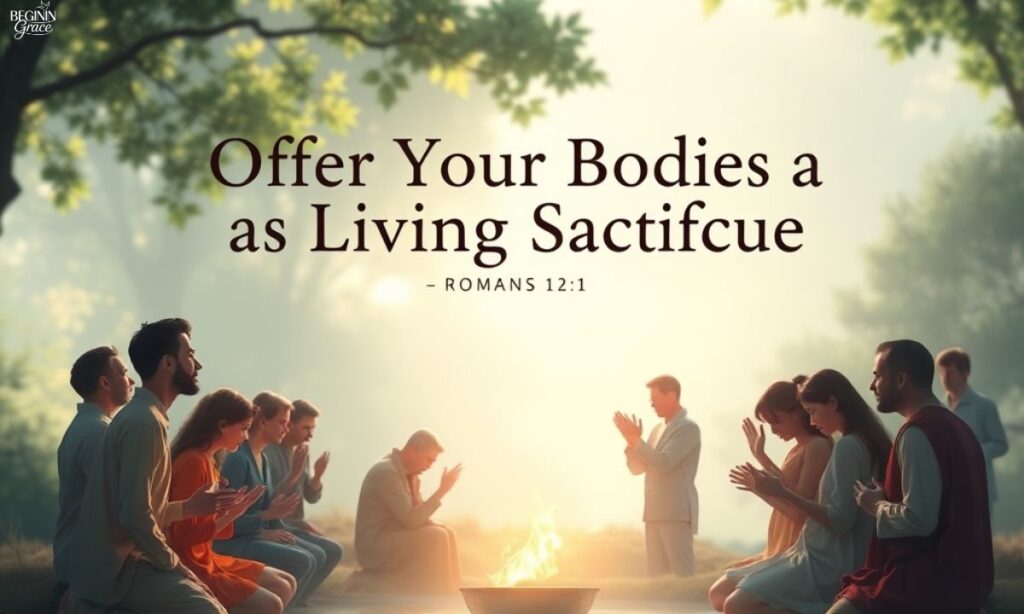
Therefore, I urge you, brothers and sisters, in view of God’s mercy, to offer your bodies as a living sacrifice, holy and pleasing to God, this is your true and proper worship.
Worship leaders often focus on what happens on stage or during designated worship time, but this verse expands the definition dramatically. True worship extends far beyond Sunday mornings, it encompasses how we use our bodies, our time, our resources, and our choices throughout the week. Help your congregation understand that worship is a lifestyle rooted in mercy and gratitude. When you remind people of God’s mercy during worship gathering times, you connect them to the motivation for offering their lives. Share stories and testimonies of how daily obedience, in work, relationships, and service, becomes an expression of worship. Lead in ways that emphasize the connection between corporate worship and individual devotion. Your leadership can inspire people to see their entire lives as an offering to God.
#6. Sing to Him a New Song Psalm 33:3
Sing to him a new song; play skillfully, and shout for joy.
God is continually doing new things. The Incarnation was new. The Resurrection was new. Pentecost was new. The gospel’s extension to the Gentiles was new. And God continues to move in fresh ways in our lives and churches. This verse gives permission, even commands, to worship leaders to embrace new expressions while maintaining skill and authenticity. Don’t feel locked into exclusively traditional or exclusively contemporary worship. Allow the Holy Spirit to inspire fresh musical expressions that reflect God’s ongoing work. This doesn’t mean abandoning proven songs and hymns, but it does mean staying alive to how God is moving today. Introduce new songs intentionally, teach them patiently, and explain how they connect to God’s timeless truths. Help your congregation understand that worshiping with new songs keeps worship fresh and expresses the reality that God is alive and active, not confined to past expressions.
#7. Offer a Sacrifice of Praise Hebrews 13:15

Through Jesus, therefore, let us continually offer to God a sacrifice of praise, the fruit of lips that openly profess his name.
The word “sacrifice” fundamentally changes how we understand praise. A sacrifice costs something. It requires surrender. This verse acknowledges that there are times when praising God feels difficult, when circumstances seem to contradict His goodness, when doubts arise, when we feel emotionally depleted. Yet even in those moments, we are called to offer praise. This is where the cross becomes central to worship leadership. Through Jesus, our sacrifice of praise becomes acceptable and powerful. Lead your congregation to understand that praising God when it’s easy is one thing, but offering praise in difficult seasons is a profound act of trust and faith. Create space in your worship gatherings to acknowledge the real struggles your people face while inviting them to declare God’s faithfulness despite circumstances. Some of the most powerful worship moments happen when a congregation courageously offers praise in the midst of pain.
#8. Worship the Lord in the Splendor of His Holiness Psalm 96:9
Worship the Lord in the splendor of his holiness; tremble before him, all the earth.
In contemporary worship, we often emphasize God’s friendship, nearness, and approachability, which are true aspects of His character. But this verse reminds us that God is also holy, magnificent, and awe-inspiring in ways that should humble us. The phrase “splendor of his holiness” suggests a radiance, a power, a set-apartness that should inspire reverence. Include moments in your worship where awe is cultivated. Use space, silence, and song selection to help people sense God’s transcendence. Balance the intimate Jesus with the majestic Creator. Balance the accessible Friend with the awesome Almighty. Help your congregation understand that holiness isn’t scary, it’s beautiful. It’s the quality that makes God trustworthy, pure, and utterly reliable. When we approach God with appropriate reverence, we position ourselves to receive more of His blessing.
#9. Holy, Holy, Holy is the Lord Almighty Isaiah 6:3

And they were calling to one another: ‘Holy, holy, holy is the Lord Almighty; the whole earth is full of his glory.
This verse captures the heavenly declaration, the very words sung around God’s throne in eternity. Isaiah’s vision shows us that even the highest beings in heaven, the seraphim, respond to God’s presence with repeated declarations of His holiness. This is not an obligation but an overflowing truth. When we sing Holy, Holy, Holy (whether the traditional hymn or other contemporary expressions), we are joining the eternal anthem of heaven. Help your congregation understand that in these moments, we are not performing for God but aligning ourselves with what already is true in the heavens. Consider incorporating this ancient declaration regularly into your worship gathering. Let people grasp that they are participating in something far larger than themselves, they are joining voices with the heavenly choir. This awareness can profoundly deepen worship from a local, time-bound activity into a participation in eternal reality.
#10. Ascribe to the Lord the Glory Due His Name 1 Chronicles 16:29
Ascribe to the Lord the glory due his name; bring an offering and come before him; worship the Lord in the splendor of his holiness.
The verb “ascribe” is significant, it’s an active choice to attribute glory to God. It’s not suggesting that God needs our praise to be glorious (He is inherently glorious), but that we choose to recognize and declare what is already true. This shifts worship from being about our needs or feelings to being about God’s worthiness. As a worship leader, your primary function is to help people focus their attention and affection on God’s glory rather than on themselves. Ask: Does this worship gathering center on God’s greatness, or on how the congregation feels? Are we lifting up His name, or are we primarily focused on our emotional response? Healthy worship balances both, but the emphasis should be on God. When you consistently direct people’s focus toward God’s attributes, His power, wisdom, love, faithfulness, justice, you cultivate congregational maturity and deeper intimacy with Him.
Leadership and Devotion in Worship

#11. Worship the Lord Your God, and Serve Him Only Matthew 4:10
Jesus said to him, ‘Away from me, Satan! For it is written: Worship the Lord your God, and serve him only.
Jesus quoted this verse in response to Satan’s temptation to bow down to him in exchange for worldly power. This teaches us something crucial: worship is an exclusive relationship. We cannot genuinely worship God while simultaneously pursuing other loyalties, other sources of identity, or other things we hope will fulfill us. As a worship leader, you’re inviting people into this exclusive devotion. Help them understand what it means to have an undivided heart before God. This doesn’t mean they can’t have jobs, relationships, or interests, but it means these things should be aligned under their primary devotion to God. In our culture, distractions and competing loyalties are endless. Your leadership can help people navigate these by regularly returning to the foundational question: Is God truly my primary allegiance, or am I dividing my loyalty among many pursuits? Create worship experiences that call people back to singular devotion.
#12. Glory in God’s Name Psalm 29:2
Ascribe to the Lord the glory due his name; worship the Lord in the splendor of his holiness.
God’s name carries weight. Throughout Scripture, names represent character and nature. When we speak God’s name or ascribe glory to it, we’re not engaging in empty religious ritual, we’re acknowledging who He actually is in all His fullness. Different names in Scripture reveal different aspects of God’s character: Jehovah-Jireh (God provides), Jehovah-Rapha (God heals), Jehovah-Shalom (God of peace). In your worship leadership, help people understand the significance of God’s names. When you pray, sing about, or declare God’s attributes, you’re making specific declarations about His character. This moves worship from vague sentimentality into concrete, meaningful engagement with God’s nature. Teach your congregation about God’s names and help them understand why we should be precise about who we are worshiping and what we’re asking Him for.
#13. Let Everything That Has Breath Praise the Lord Psalm 150:6
Let everything that has breath praise the Lord. Praise the Lord.
This verse is the final statement in the Psalter, the culminating truth of the entire collection of prayers and songs. It’s not “let the talented musicians praise the Lord” or “let the spiritually mature praise the Lord.” It’s everything with breath. This is radically inclusive. As a worship leader, one of your essential tasks is to create a space where every person, regardless of musical ability, spiritual maturity, cultural background, or current circumstances, feels invited to participate in praising God. Break down barriers that might keep people silent. Help people understand that their participation matters to God. The sound God most wants to hear is the voice of His people, each contributing their unique expression of faith. Don’t let worship become a performance where the congregation watches while a few people on stage do the worshiping. Work intentionally to increase congregational participation and help people grasp that their voice, their individual, unique voice, matters in heaven.
#14. Speak to One Another with Psalms, Hymns, and Songs Ephesians 5:19-20
Speak to one another with psalms, hymns, and songs from the Spirit. Sing and make music from your heart to the Lord, always giving thanks to God the Father for everything, in the name of our Lord Jesus Christ.
Here’s a profound insight: worship songs aren’t only vertical (directed to God), they’re also horizontal (directed to each other). When your congregation sings together, they are mutually encouraging one another in faith. The person next to you who is struggling needs to hear your voice declaring God’s faithfulness. You need to hear the faith expressed in your neighbor’s singing. This creates accountability and community within worship. Choose songs that have edifying value for the congregation’s mutual encouragement, not just songs that create good musical moments. Be intentional about including portions of your worship gathering where people face each other (if possible) rather than only looking forward. Help your congregation understand that their participation strengthens the entire body. Worship is not primarily about the quality of the performance but about the community’s collective expression of faith and mutual building up in Christ.
#15. Sing Praises to Our King Psalm 47:6-7
Sing praises to God, sing praises; sing praises to our King, sing praises. For God is the King of all the earth; sing to him a psalm of praise.
The repetition in this verse is striking, sing praises, sing praises, sing praises, emphasizing both the importance and the joy of expressing praise. The focus on kingship is also significant. In a culture that often resists authority and assumes individual autonomy, acknowledging God as King calls for a specific posture: submission, recognition of a rule beyond ourselves, and alignment with a kingdom not of our making. As a worship leader, help your people understand what it means to worship a King. This isn’t about slavery or oppression but about the freedom and security that comes from aligning ourselves with the ultimate authority in the universe. A king rules for the welfare of his subjects. God’s kingship is always exercised with perfect justice, compassion, and wisdom. When we acknowledge His reign, we yield our need to control everything and receive His protection and provision instead.
#16. Declare the Praises of Him Who Called You 1 Peter 2:9
But you are a chosen people, a royal priesthood, a holy nation, God’s special possession, that you may declare the praises of him who called you out of darkness into his wonderful light.
Peter’s declaration is stunning: you are chosen, you are priests, you are holy, you are God’s special possession. These identities are not earned through performance or merit, they are bestowed through God’s grace. The purpose of these identities is to declare God’s praises. As a worship leader, you carry a special responsibility to help people understand their own identity before God. Many people come to worship carrying shame, inadequacy, or questions about their worth. Your leadership can help them encounter the truth of their identity in Christ. Create moments in worship where you help people grasp that they are not failures trying to become acceptable, they are already chosen, already claimed, already royalty in God’s kingdom. From this foundation of identity, praise flows naturally. Help your congregation understand that declaring God’s praises is not a religious obligation but a joyful response to the reality of who they are and what God has done for them.
#17. You Are Worthy to Receive Glory and Honor Revelation 4:11
You are worthy, our Lord and God, to receive glory and honor and power, for you created all things, and by your will they were created and have their being.
This verse comes from John’s vision of heaven, where the elders fall down and acknowledge God’s worthiness based on His identity as Creator. Everything that exists, visible and invisible, material and spiritual, past and future—exists because God created it and sustains it. When we worship a Creator of this magnitude, we are not worshiping a deity confined to our understanding or limited by our expectations. We are encountering the ground of all beings. Help your congregation grasp the cosmic significance of worship. Sing about creation. Spend time contemplating God’s power. Help people understand that worshiping a God who created galaxies and sustains atoms is radically different from worshiping human-sized gods of our own making. When people encounter the magnitude of God’s creative power and sovereignty, it recalibrates their entire perspective. Problems that seemed overwhelming become manageable in light of a God who sustains the universe.
#18. I Will Bless the Lord at All Times Psalm 34:1
I will bless the Lord at all times; his praise will always be on my lips.
The psalmist makes a vow: at all times. Not just in pleasant circumstances. Not just when worship flows easily. Not just when surrounded by community. At all times. This is a commitment to cultivate a lifestyle of blessing God, of speaking praise habitually and regularly. As a worship leader, you can encourage this by helping people develop individual worship practices that extend beyond Sunday mornings. Suggest daily spiritual disciplines like morning prayers of thanksgiving, evening reflections on God’s faithfulness, or throughout-the-day awareness of God’s presence. Help your congregation understand that corporate worship is not the only place or time to praise God. The goal is not to create dependence on the gathered community for spiritual vitality but to equip people to maintain an ongoing relationship with God. Some of the people in your congregation may face weeks where they cannot gather with the community due to illness, work demands, or crises. Teaching them to bless the Lord independently makes their faith resilient.
God’s Strength and Deliverance

#19. Sing for Joy to God Our Strength Psalm 81:1
Sing for joy to God our strength; shout aloud to the God of Jacob.
Notice the connection: singing for joy is connected to recognizing God as strength. Our joy is not based on our circumstances or capabilities but on God’s proven power. This is especially meaningful for congregations going through trials. When people understand that their God has power, that He has delivered before, that He is strong enough to handle anything, joy becomes possible even in difficulty. Include times in your worship gathering where you specifically celebrate God’s power and ask Him to strengthen His people. Help people process their fears and challenges by bringing them into worship and laying them before the God of strength. Sometimes the most powerful moment is when someone in despair hears the congregation singing about God’s power and suddenly grasps that this power is available to them. Your leadership can facilitate these breakthrough moments by creating space for people to bring their real struggles into worship.
#20. I Called to the Lord, Who Is Worthy of Praise 2 Samuel 22:4
I called to the Lord, who is worthy of praise, and have been saved from my enemies.
David’s testimony connects calling out to God with salvation. This is not theoretical theology, it’s the record of someone who faced real enemies and experienced real deliverance. When you lead worship, you’re inviting people into a similar testimony dynamic: bring your struggles to God, trust Him for deliverance, and then praise Him for His faithfulness. Help your congregation share their testimonies of God’s deliverance. Create space for people to articulate how God has come through for them. When others hear specific stories of how God has saved, protected, healed, or provided, their faith is strengthened. They understand that the God they worship is not abstract, He acts in real time in real lives. Your leadership can normalize the sharing of testimony and help people understand that telling their stories of God’s faithfulness is a form of worship that edifies the entire community.
#21. I Will Give Thanks to You, Lord, with All My Heart Psalm 9:1
I will give thanks to you, Lord, with all my heart; I will tell of all your wonderful deeds.
Wholehearted thanks is transformative. When gratitude is not obligatory or performative but genuine and comprehensive, it changes our internal orientation. Instead of focusing on what we lack, we remember all God has done. Instead of comparing ourselves to others, we recall His kindness to us specifically. As a worship leader, you can cultivate gratitude by intentionally directing people’s attention to God’s wonderful deeds. Share stories of answered prayers. Highlight answered prayers from the congregation. Help people remember acts of God’s kindness they may have forgotten. Create a culture where thanksgiving is not limited to holiday gatherings but woven throughout your worship experiences. Help your congregation understand that gratitude is not a feeling to be manufactured but a natural response to remembering what God has done. When people are grateful, they worship more freely and joyfully.
#22. The Lord Your God Is With You, the Mighty Warrior Zephaniah 3:17
The Lord your God is with you, the Mighty Warrior who saves. He will take great delight in you; in his love he will no longer rebuke you, but will rejoice over you with singing.
This verse combines power with tenderness in a stunning way. God is mighty enough to fight our battles, yet tender enough to delight in us and rejoice over us. The image of God singing over us with joy is extraordinary. It reverses the typical understanding of worship, usually we imagine singing to God, but here we glimpse God singing over us, delighting in His people. Help your congregation grasp this reality: they are not serving a distant, stern deity who tolerates them grudgingly. They are beloved by a God who takes delight in them, whose love is not conditional on their performance, and who considers them worthy of singing over. This transforms worship from obligation into response to being loved. Create space in your worship where people can receive love, can experience God’s delight, and can rest in being valued. Some of the people in your congregation carry deep shame or feelings of worthlessness. Your leadership can help them encounter God’s affection for them.
#23. Sing the Glory of His Name Psalm 66:2
Sing the glory of his name; make his praise glorious.
There’s a paradox here: God’s glory is already complete and magnificent. Yet we are invited to make His praise glorious, to amplify, declare, and lift it up. Our singing doesn’t create God’s glory, but it does give expression to it and spreads awareness of it. This is empowering for worship leaders: you are not generating something from nothing, but you are channeling, expressing, and declaring what already exists. When you lead with confidence that God’s glory is real and magnificent, that confidence transfers to your congregation. Choose songs that expand and magnify God’s name. Help people understand that singing about God’s attributes, His justice, His mercy, His wisdom, His power, is not empty praise but a meaningful act of pointing others toward His glory. In a culture that often demands that we make ourselves glorious, worship offers a refreshing alternative: we get to lift someone else up, to point beyond ourselves to the genuinely glorious One.
#24. Under the Direction of Their Father They Sang 1 Chronicles 25:6
Under the direction of their father they sang songs of praise to the Lord, with musical instruments, according to the command of the king.
This verse highlights the importance of order and intentional leadership in worship. The singers were “under direction, they had leadership, structure, and purpose. This doesn’t mean worship should be rigid or joyless; rather, it means worship should be intentionally stewarded. As a worship leader, you have the responsibility to thoughtfully guide your congregation. Plan your worship gatherings with care. Think about song selection, pacing, transitions, and themes. Consider the spiritual journey you’re inviting people on. Communicate with your team so everyone understands the direction and purpose. Help your musicians and other worship team members understand that they are not performing for the congregation but serving the congregation’s encounter with God. Structure and intentionality actually create freedom, when people understand the flow and purpose, they can relax and engage more deeply rather than wondering what’s happening next.
#25. Praise the Lord, My Soul Psalm 103:1
Praise the Lord, my soul; all my innermost being, praise his holy name.
The psalmist addresses his own soul, calling it to praise. This suggests that praise is not always automatic or easy—sometimes we must intentionally call ourselves to praise. We must override our resistance, our doubt, our distractions, and choose to praise anyway. This is liberating for people who feel they don’t “feel” like worshiping on a given Sunday. Worship is not contingent on feeling; it’s a choice that emotions can follow. Help your congregation understand that they have agency in worship. They can choose to praise even when they don’t feel like it. They can call their own souls to attention and declare God’s worthiness. This transforms worship from something that happens to you into something you actively participate in creating. When people understand this, they become empowered agents in their own spiritual growth rather than passive consumers waiting to feel inspired.
The Nature and Purpose of Praise

#26. Bless the Lord, O My Soul Psalm 104:1
Praise the Lord, my soul. Lord my God, you are very great; you are clothed with splendor and majesty.
This opening of Psalm 104 invites us into a contemplative stance before God’s magnificence. The language of splendor and majesty suggests something beyond our full comprehension, something that evokes awe and wonder. In your worship, create space for contemplation and awe, not just celebration and excitement. Include moments of quietness and reflection where people can ponder the magnitude of God. Use imagery from creation and the natural world to help people recognize God’s splendor all around them. Help your congregation slow down enough to really think about who God is and how vast the difference between Him and us actually is. In a culture that prizes constant stimulation and entertainment, offering space for awe and contemplation can be countercultural and deeply refreshing.
#27. Great Is the Lord and Worthy of Praise Psalm 48:1
Great is the Lord and most worthy of praise; in the city of our God, his holy mountain.
Greatness and praise are inseparably connected here. The more we understand God’s greatness, not just intellectually but in a way that touches our hearts, the more naturally praise flows. As a worship leader, your task includes helping people grasp the scope of God’s greatness. This might mean explaining the size of the universe, the intricacy of creation, the vastness of God’s knowledge, the reach of His love across millennia. When people understand God’s greatness, their problems shrink into proper perspective. Fears that felt overwhelming become manageable. Uncertainties that felt paralyzing become navigable. Help your congregation grow in their understanding and experience of God’s greatness, and praise will follow naturally.
#28. O Magnify the Lord with Me Psalm 34:3
Glorify the Lord with me; let us exalt his name together.
Notice the communal aspect: magnifying the Lord together. Worship is not a solitary activity (though personal worship is important). There’s something powerful about multiple voices, hearts, and spirits united in exalting God. The word magnify is interesting, it means to make something appear larger. God doesn’t become larger when we magnify Him, but our perception of His greatness expands, and our focus on Him increases. In corporate worship, help your congregation understand that they are not just singing for themselves or even primarily for God (though worship is directed toward Him). They are also strengthening each other’s faith, building community, and creating an atmosphere where God’s presence is recognized. The power of gathered worship comes partly from the mutual encouragement and witness of people declaring truth together.
#29. Shout for Joy to God Psalm 47:1
Clap your hands, all you nations; shout to God with cries of joy.
This verse gives full permission for exuberant, unbridled worship. Not everyone worships the same way, some are more reserved, some more expressive. But this verse validates enthusiastic, joyful expressions. As a worship leader, help create space where all types of worship expression are welcomed and valued. Some will clap, some will lift hands, some will kneel, some will close their eyes and sway. Affirm that different expressions of worship are valid. Help people understand that worship is not about conforming to a particular style but about authentically expressing your relationship with God. If your church culture tends toward reserve, gently expand the range of acceptable expressions. If your church culture is very expressive, help ensure that quieter, more contemplative expressions are also valued.
#30. I Will Sing of Your Love and Justice Psalm 101:1
I will sing of your love and justice; to you, Lord, I will sing praise.
This verse acknowledges two seemingly opposite qualities that must be held together in God: love and justice. God’s love is not sentimental or permissive, it coexists with His justice. His justice is not harsh or cold, it flows from His love. In worship, help your congregation understand this paradox. God is tenderly compassionate and firmly just. He offers unlimited grace and maintains absolute standards. Both are true simultaneously. Songs that celebrate only God’s gentleness without acknowledging His justice create an incomplete picture. Songs that emphasize only judgment without God’s love become oppressive. Aim for balance, choosing songs that reflect the fullness of God’s character. Help people understand that they can trust a God who is both loving and just.
Building Community Through Worship

#31. Sing and Make Music in Your Heart Ephesians 5:19
Speaking to one another with psalms, hymns, and songs from the Spirit. Sing and make music from your heart to the Lord,
The emphasis on making music “from your heart” underscores that authentic worship is not about technical perfection but about sincere engagement. You don’t need the best singers or most expensive instruments to create powerful worship—you need people willing to open their hearts. Sometimes the most moving worship experiences happen with simple instruments or untrained voices, because the sincerity is palpable. As a worship leader, help your congregation understand this. Encourage people to participate even if they feel they don’t have good singing voices. Help musicians and singers focus on authenticity rather than flawlessness. Share the truth that God is far more interested in the condition of our hearts than in the quality of our performances. When people relax into genuine expression rather than striving for perfection, worship becomes transformative.
#32. Make a Joyful Noise Psalm 100:1
Shout for joy to the Lord, all the earth.
The Hebrew phrase “make a joyful noise” has been translated various ways, but the core idea is unmistakable: worship involves audible expression of joy. Silence can have its place in worship, but so does noise, uninhibited, enthusiastic, joyful noise. In congregations that tend toward quietness, this verse gives permission to be louder, freer, more exuberant. Help people understand that subdued, whispered worship and loud, exuberant worship both have their place. The key is that whatever we do should reflect genuine joy and authentic engagement with God. Create opportunities where people can express joy freely without worrying about disturbing others or appearing foolish. When people give themselves permission to make a joyful noise, something liberating happens. Inhibitions release, joy becomes contagious, and worship reaches new depths.
#33. Come, Let Us Bow Down in Worship Psalm 95:6
Come, let us bow down in worship, let us kneel before the Lord our Maker.
Bowing and kneeling are physical expressions of submission and reverence. While not every person can physically bow (due to age or ability), the principle remains: worship involves yielding ourselves to God’s authority. In your worship leadership, you can invite people into physical expressions of submission, kneeling, bowing, raised hands, or other gestures. These physical expressions often help inner spiritual realities become more concrete and real. There’s something about the body that, when it bows, helps the spirit also surrender. Help your congregation understand that bodies matter in worship. We’re not disembodied spirits having experiences; we are whole persons, body, soul, and spirit, engaging with God. What we do with our bodies in worship often reflects and deepens what’s happening in our hearts.
#34. I Lift My Eyes to the Mountains Psalm 121:1
I lift my eyes to the mountains, where does my help come from.
This psalm begins with a question, an honest look at our limitations and needs. The psalmist is acknowledging that help must come from beyond ourselves. Worship that begins with honesty about our need creates space for authentic encounter with God who provides. Help your congregation understand that worship is not about pretending we have it all together. It’s about bringing our real selves, our questions, doubts, fears, and needs, before God. When worship gatherings allow space for honest questions and vulnerability, deeper transformation happens. People realize they’re not alone in struggling, and they encounter a God who is big enough to handle their biggest questions.
#35. You Make Known to Me the Path of Life Psalm 16:11
You make known to me the path of life; in your presence there is fullness of joy; in your right hand are pleasures forevermore.
This verse promises that in God’s presence, we find fullness of joy and eternal pleasure. Worship is not meant to be grim or obligatory, it’s meant to be one of life’s greatest joys. Help your congregation understand that pursuing God’s presence is the path to genuine joy. Everything else we pursue, success, relationships, possessions, experiences, can provide temporary satisfaction, but only God’s presence offers fullness. Create worship experiences where people can genuinely encounter God’s presence and taste this fullness. When people experience God’s presence, their priorities align differently. They begin to understand why sacrifice and obedience make sense, because what we gain is infinitely greater than what we give up.
#36. My Soul Yearns, Even Faints, for You Psalm 84:2
My soul yearns, even faints, for you, my God. My whole being longs for you.
The language here is intensely passionate and personal. This is not a dutiful religion but deep longing. The psalmist’s entire being, not just his mind or will, but his soul, aches for God. This kind of passionate desire for God is often missing in contemporary Christianity. We can become so practical and busy that we lose the element of yearning and longing. As a worship leader, you have the opportunity to awaken or deepen this spiritual longing. Create worship experiences that invite people into passionate, wholehearted desire for God. Help them understand that it’s okay, even good, to long for God deeply. Normalize this kind of spiritual passion. Help your congregation understand that the deepest joy comes not from having our needs met but from encountering the One who meets them.
#37. As the Deer Pants for Streams of Water Psalm 42:1
As the deer pants for streams of water, so my soul pants for you, my God.
This beautiful metaphor from nature helps us understand spiritual thirst. A deer that has been running or is in danger desperately seeks water. The image is not of lazy desire but of urgent, life-dependent need. Our souls should hunger for God with that same intensity. In a culture that offers countless diversions and alternative sources of fulfillment, help your congregation remember their primary thirst. Worship can awaken or deepen this thirst by constantly pointing them back to God as the source of everything they truly need. When people feel their spiritual thirst awakened and satisfied in God’s presence, other lesser thirsts lose their power over them.
#38. You Are My Strength and My Shield Psalm 28:7
The Lord is my strength and my shield; my heart trusts in him, and he helps me. My heart leaps for joy, and with my song I praise him.
This verse connects trust with both strength and joy. When we trust God with our real fears and needs, we access His strength (which becomes our strength) and His protection (the shield). The natural result is that our hearts leap for joy. As a worship leader, help people understand this progression: trust God → access His strength → experience His protection → find reason for joy. Help your congregation bring their real fears into worship. Don’t hide behind platitudes about faith. Instead, acknowledge the real fears and challenges people face, then help them see how God’s character addresses those fears. When people experience God meeting their needs and protecting them, worship becomes not an obligation but an overflowing response to His faithfulness.
#39. God is Our Refuge and Strength Psalm 46:1
God is our refuge and strength, an ever-present help in trouble.
The beauty of this verse is its consistency: God is always available, always present, always ready to help. We don’t need to petition Him to start helping, He’s already there. His help is ever-present.” This is deeply comforting for people going through trials. In your worship leadership, especially when leading congregations that include people in crisis, remember this truth. Worship doesn’t solve problems, but it connects us with the One who is present in the midst of problems. Sometimes the most powerful worship moments happen in hospitals, funeral homes, and disaster zones where people gather to declare that God’s presence is real even in tragedy. Help your congregation understand that worship is not a luxury for times when life is going well, it’s a necessary spiritual discipline for all seasons.
#40. The Lord Is My Light and My Salvation Psalm 27:1
The Lord is my light and my salvation, whom shall I fear? The Lord is the stronghold of my life, of whom shall I be afraid.
This psalm moves from declaration of God’s character to rhetorical questions that assume we already know the answers. When the Lord is our light (dispelling darkness), our salvation (providing rescue), and our stronghold (protecting us), the logical response is confidence. There’s nothing to fear. Help your congregation make this connection in their own lives. What fears are they carrying? How do those fears change when they contemplate that the God of light, salvation, and protection is on their side? Light and darkness are powerful metaphors that resonate across cultures and generations. Songs about God as our light can help people understand how faith dispels fear, not by denying danger but by focusing on a greater reality, God’s presence and power.
#41. I Have Set My Lord Always Before Me Psalm 16:8
I have set the Lord always before me. Because he is in my right hand, I will not be shaken.
The psalmist’s commitment is to keep God’s presence central in consciousness. Always is the key word. Not just on Sundays, not just in crisis moments, but always, the Lord is the central focus, the reference point for all decisions and perspectives. When God remains central, we remain stable (“I will not be shaken”). As a worship leader, you’re inviting people into this same practice. Help them develop awareness of God’s presence throughout their day. Encourage practices like brief prayers, Scripture memory, and moments of conscious acknowledgment of God’s nearness. When people develop the habit of God-awareness, their stability and confidence increase. They’re less thrown off by circumstances because they’re anchored to something greater than circumstances.
#42. Enter His Gates with Thanksgiving Psalm 100:4
Enter his gates with thanksgiving and his courts with praise; give thanks to him and praise his name.
This verse maps a progression into God’s presence: first thanksgiving, then praise. Beginning with gratitude creates the right internal posture for encountering God. Gratitude shifts our focus from what we lack to what we’ve been given. It opens our hearts to receive more. As a worship leader, you can establish this progression in your worship gatherings. Begin with thanksgiving, directing people to remember what God has done, what He’s provided, how He’s cared for them. Allow this gratitude to naturally flow into praise, exalting His name and character. This progression, when done authentically, creates a powerful entry into worship. People arrive often preoccupied with their worries and concerns. Starting with thanksgiving helps them transition emotionally and spiritually into a posture where they can genuinely worship.
#43. Praise the Lord from the Heavens Psalm 148:1
Praise the Lord. Praise the Lord from the heavens; praise him in the heights.
This psalm expands the scope of worship to include all of creation. Heavenly beings, angels, and all creation are invited to participate in praising God. This is a cosmic vision of worship where we are joining voices with the entire universe in declaring God’s greatness. Help your congregation grasp this perspective. When they sing, they’re not isolated individuals in a small building—they’re joining an eternal chorus. This awareness can be incredibly powerful and humbling. It connects them to something vastly larger than themselves. Songs that reference God’s cosmic greatness, His rule over all creation, and the participation of all things in His praise can help people experience this expanded sense of worship.
#44. Blessed Are Those Whose Strength is in You Psalm 84:5
Blessed are those whose strength is in you, whose hearts are set on pilgrimage.
The image of pilgrimage is significant, worship is not a destination we arrive at once and for all, but a journey we’re on continuously. Those who keep their hearts set on moving toward God, on growing in their faith, on drawing closer to His heart, these are the blessed ones. As a worship leader, help your congregation understand that they’re on a pilgrimage, not a finished journey. Each worship gathering is a waypoint on a longer journey of following Jesus. This perspective helps address both those who feel they haven’t progressed enough and those who might think they’ve arrived. The goal is always deeper intimacy with God, greater surrender to His will, and more complete conformity to Christ’s image. Worship facilitates this ongoing pilgrimage.
#45. O Sing to the Lord a New Song Psalm 96:1
Sing to the Lord a new song; sing to the Lord, all the earth.
Newness appears again in Scripture’s invitation to worship. The gospel itself is new every morning,” as Lamentations reminds us. God’s mercies don’t get old or stale. Our response in worship should reflect this ongoing freshness. As a worship leader, you have permission, and perhaps a responsibility, to keep worship fresh. This doesn’t mean abandoning timeless truths or beautiful, proven songs. It means being open to how God is moving freshly in your context, in your generation, in this particular congregation. Introduce new songs intentionally. Update arrangements of familiar songs. Try new approaches to worship experiences. Help your congregation understand that “new” doesn’t mean “abandoning the old, it means responding to God’s ongoing activity with fresh expressions of faith.
#46. My Heart and Flesh Cry Out for the Living God Psalm 84:2
My soul yearns, even faints, for you, my God.
The integration of body and spirit in worship is emphasized here—not just the heart, but the whole being crying out for God. We’re not disembodied spirits; we’re embodied souls. Our physical bodies, our emotions, our minds, and our spirits all participate in worship. Help your congregation understand that worship involves the whole self. It’s not just intellectual agreement or emotional feeling, it’s wholehearted, whole-person engagement with God. This might mean creating space for various physical expressions of worship. It might mean acknowledging that emotions are valid in worship. It means recognizing that our thoughts matter and our bodies matter, all in service of encountering the living God.
#47. I Will Extol the Lord at All Times Psalm 34:1
I will extol the Lord at all times; his praise will always be on my lips.
This is a life commitment to ongoing praise. Not praise in the worship gathering only, but praise as a way of life. This transforms our perspective and language. When praise is always on our lips, it shapes how we speak about circumstances, how we respond to others, and how we navigate challenges. As a worship leader, you’re inviting people into this lifestyle commitment. Help them understand that they’re not just attending a worship service, they’re being invited into a way of life marked by continuous thankfulness and praise. This lifestyle witness is powerful. When others see believers who consistently respond with praise and gratitude even in difficulty, it’s a powerful testimony to God’s character.
#48. The Heavens Declare the Glory of God Psalm 19:1
The heavens declare the glory of God; the skies proclaim the work of his hands.
Creation itself is a form of worship—it’s constantly declaring God’s glory. We experience this glory when we pay attention to creation: a sunset, a mountain vista, a newborn child, the vastness of the ocean. As a worship leader, help your congregation develop eyes to see God in creation. Use nature imagery in your worship. Encourage outdoor worship experiences when possible. Help people understand that their appreciation of beauty, their sense of awe in nature, is a spiritual experience. This helps people understand that worship happens in multiple contexts and that our spiritual lives extend beyond church buildings. When we help people see all of creation as a declaration of God’s glory, we expand their capacity to worship in all seasons and places.
#49. Come, Let Us Return to the Lord Hosea 6:1
Come, let us return to the Lord. He has torn us, but he will heal us; he has injured us, but he will bind up our wounds.
This verse acknowledges that sometimes the journey with God includes wounding—discipline, correction, the consequences of our own choices. Yet it also declares that God’s intent in these difficult seasons is healing and restoration. This is important for congregations that may be carrying shame or pain. Worship can be a place where people understand that God’s love includes correction, and that even difficulty can be redemptive. Help your congregation understand that returning to God is always possible, always welcomed. Create space in worship for repentance and restoration. Some of the most transformative worship moments happen when people acknowledge their failures and receive God’s healing grace.
#50. Sing for Joy, O Heavens Isaiah 49:13
Shout for joy, O heavens; rejoice, O earth; burst into song, O mountains! For the Lord comforts his people and will have compassion on his afflicted.
This final verse invites all of creation to participate in joy over God’s compassion toward His people. The particular focus is on God’s comfort and compassion for those who are afflicted. Worship, at its heart, is declaring that we have a God who cares about suffering, who offers comfort, and who comes with compassion. As a worship leader, remember that your congregation includes people in various states of brokenness and affliction. Your leadership can create space where these wounded ones encounter God’s comfort. Sometimes the most profound worship happens not in moments of exuberance but in quiet moments when someone feels truly seen and cared for by God. Help your congregation understand that God’s compassion is not a cold obligation but deep, caring, active concern for each person’s well-being.
Frequently Asked Questions
What are the best Bible verses for worship leaders
Verses like Psalm 95:6 and John 4:24 guide worship leaders toward true, heartfelt worship.
Which scriptures help worship leaders stay focused
Passages on humility, service, and praise help leaders keep their purpose clear.
What Bible verse inspires worship teams
Psalm 100:2 reminds teams to serve the Lord with gladness.
What verse shows how to lead worship with a pure heart
Psalm 51:10 highlights the importance of a clean and renewed heart.
What Bible verses encourage worship leaders during stress
Isaiah 40:31 offers strength and hope during demanding seasons.
Which scripture guides worship leaders in truth
John 4:23–24 teaches worship in spirit and truth.
What verse can worship leaders read before service
Psalm 118:24 encourages joy and gratitude as service begins.
What Bible verses motivate worship leaders to serve faithfully
Colossians 3:23 reminds leaders to work wholeheartedly for the Lord.
Which verses help worship leaders stay humble
Philippians 2:3–4 teaches humility and putting others first.
What verse helps worship leaders rely on God
Proverbs 3:5–6 encourages trusting God’s direction over our own.
Closing Thoughts
The journey of a worship leader is one of the greatest privileges available to the church. You stand in a unique position where you help shape how God’s people encounter Him, how they understand themselves in relation to His character, and how they live out their faith in the world. The fifty verses in this article represent centuries of God’s people expressing their faith, their questions, their fears, and their joy in God’s presence. Each of these passages invites you into a deeper understanding of what worship truly is and what it can be in your own leadership.
As you implement these biblical foundations into your ministry, remember that you are not tasked with creating a perfect performance or orchestrating emotional responses. Rather, you are invited to create sacred space where the Holy Spirit can work, to shepherd hearts toward genuine encounter with the living God, and to equip believers to live lives of worship in every context. The songs you select, the words you speak, the atmosphere you cultivate—all of these matters because they communicate theological truth and invite spiritual transformation. May these verses anchor your leadership in Scripture, deepen your own relationship with God, and empower you to guide your congregation toward the authentic, transformative worship that honors God and blesses His people. Your faithfulness in this calling matters more than you may ever fully know.

Samuel Reed is a devoted Christian writer with 4 years of experience sharing Bible verses, blessings, and prayers on Beginingrace.com. His writings reflect faith, hope, and the peaceful message of God’s grace for every heart